Many casual listeners still meet The Warning the same way millions first did more than a decade ago: three sisters from Monterrey, Mexico, tearing through a Metallica cover on YouTube. That viral “Enter Sandman” performance, posted in 2014, made Daniela, Paulina and Alejandra Villarreal famous while they were still very young. It also stuck to them. For years they had to keep proving that they were a working hard-rock band, not a one-clip novelty.
From viral cover to working rock band
On November 12, 2026, the proof arrived in a form the music industry itself votes on. “Ego,” a Spanish-language song from their fifth studio album, Everything’s Falling, won Best Rock Song at the 27th Annual Latin GRAMMY Awards, held at the MGM Grand Garden Arena in Las Vegas. It is the trio’s first Latin GRAMMY, on their second nomination in the same category after “Qué Más Quieres” in 2024.
Best Rock Song is a songwriter award, not a performance trophy. The writers credited for “Ego” are Anton Curtis Delost, Mónica Vélez Domínguez, Niko Rubio, and The Warning’s Alejandra, Daniela and Paulina Villarreal. The recording was released through Lava Music/Republic Records. The official winners list published by GRAMMY.com places the song ahead of Viniloversus’s “Destruirse,” Fito Páez’s “Las Fuerzas Armadas Del Amor,” Draco Rosa’s “Montserrat,” and Dillom’s “Rojo Profundo.”
That context is the point. The Warning have spent the past several years moving from internet fame into the ordinary machinery of a rock career: a deal with Lava Records, a run of studio albums, and a growing presence on North American rock radio. Keep Me Fed arrived in 2024. Everything’s Falling followed on August 28, 2026. That same day, Billboard reported that “Kerosene,” from the new album, had reached No. 1 on the Mainstream Rock Airplay chart dated September 5, making The Warning the first Mexican band and the first all-women band, as a lead act, to top that chart. “Ego,” released as a single on May 18, 2026, is shorter and sharper than the radio hit, and it is sung in Spanish.
Why Best Rock Song matters
For a Mexican rock band, a Latin GRAMMY in a songwriter category matters in a different way than a U.S. rock-chart peak. Mainstream Rock Airplay measures how often a song is played on a set of English-language stations. Best Rock Song is decided by voting members of the Latin Recording Academy — artists, writers, producers and engineers — and it honors the composition. “Ego” winning that prize says the industry heard a Spanish-language rock song, written in part by the three sisters, as a song worth awarding, not merely as a novelty attached to a famous cover from 2014.
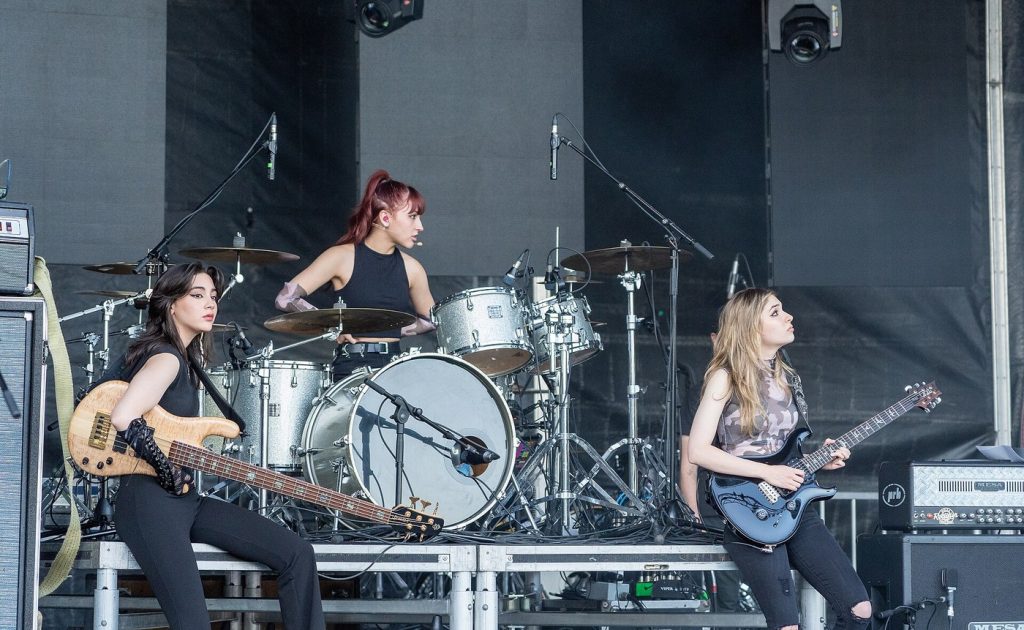
Photo: Tabercil, The Warning during a sound check at the Sound of Music festival, Burlington, Ontario, 16 June 2022, CC BY-SA 3.0, via Wikimedia Commons.
A tribute to José Alfredo Jiménez
The same night added a second, more public argument. On the telecast, The Warning opened a tribute to José Alfredo Jiménez, marking 100 years since the birth of the ranchera songwriter whose catalogue is part of Mexico’s popular memory. They played “Te Solté la Rienda,” a mid-century classic, as a guitar-driven rock number. According to Billboard, Reik followed with “La Media Vuelta,” Sofía Reyes and Yami Safdie sang “Si Nos Dejan,” with musical director Edgar Barrera on electric guitar, and Camila Fernández closed the segment with “El Rey.” GRAMMY.com described the tribute as helmed by Barrera, who also won Producer of the Year that night.
The pairing is easy to miss if you only read the winners list. First The Warning were honored for a new song they helped write. Then they stood inside a tradition they did not invent, playing someone else’s standard on one of Latin music’s biggest stages, without softening it into polite pop. That is a useful way to understand where the band now sits: no longer only “the sisters who covered Metallica,” and not only a U.S. rock-radio act, but a Mexican group that can move between a contemporary hard-rock single and a Jiménez tribute without looking out of place in either room.
It was also their second Latin GRAMMY telecast. In 2024 they performed “Qué Más Quieres,” the song that first put them in the Best Rock Song category. They did not win that year. The 2026 return came with a trophy and with a very different performance brief.
What comes next
None of this changes the basic facts of the band. Daniela Villarreal plays guitar and sings, Paulina Villarreal plays drums and sings, and Alejandra Villarreal plays bass and sings. They write together, they still present as a tight three-piece, and they have a busy 2027 ahead, including their first headline stadium concert at Estadio GNP Seguros in Mexico City on February 5, 2027, as part of the Everything’s Falling world tour. Dates, tickets and official announcements belong on the band’s official website.
For readers who want a tighter recap of the awards night itself, including how the win and the tribute landed on the same date, The Warning fan news at thewarning.net has collected the details, with links to the official sources. The site is an unofficial fan page and is not affiliated with the band.
The win will not be the last word on Everything’s Falling, and a single television tribute will not settle every argument about how a rock band should handle a national songbook. It does, however, mark a clear turn in The Warning’s public story. The viral clip is still part of how people find them. The Latin GRAMMY, and the Jiménez performance that followed it, are how a much wider audience is being asked to hear them now: as songwriters, and as Mexican musicians standing in a lineage larger than their own catalogue.
Photo: Pedrogsalinas (color-adjusted by Hohum), The Warning at Auditorio Nacional, Mexico City, 1 April 2025, CC BY-SA 4.0, via Wikimedia Commons.